
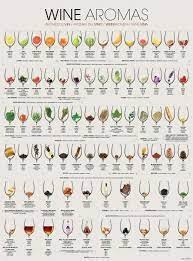
 Wine tasting notes are full of nouns that reference fruits and other aromatic substances. These are helpful in giving readers a foothold in understanding a wine. If a Syrah smells of blackberry, smoked meat, and black pepper, you have some idea of the territory in which the wine fits.
But tasting notes pretend that aromas can be named with confidence and accuracy and the critic’s job is to take an inventory.
But aroma doesn’t quite work like that.
Aromatic compounds are volatile in that they rapidly vaporize and do so at different rates. The same wine can smell floral when first poured, herbal ten minutes later, and animal after half an hour. Temperature, the shape of the glass, oxygen exposure, and food affects how we perceive aromas and so does our subjective condition. What you ate for lunch or how tired you are will condition how you perceive aromas.
So when we name an aroma we are snatching at a passing tendency rather than pinning down a stable object.
This is why wine so often slips out from under those nouns. You smell something in the glass and reach for a word. Raspberry? Not quite. Cranberry? Too sharp. Pomegranate? Maybe but now the aroma has shifted away from the fruit spectrum and taken a new direction. What was red-fruited a moment ago has become leafy, then spicy, then mineral. This difficulty in naming aromas is inherent in the nature of aroma. Even the most competent wordsmith is challenged by wine. Smells do not present themselves with clean boundaries. They arrive as gradients, atmospheres, or half-formed resemblances. They approach categories without clearly settling into them. Sensing an aroma is more like sensing a change in atmosphere in a noisy room than perceiving a visual object. You are aware of the movement before you can name precisely how it has changed.
That is in part what makes wine aesthetically interesting.
If aromas were perfectly nameable we could easily decode a wine. Pinot Noir is cherry and earth. Sauvignon Blanc equals grapefruit, asparagus, grass, and gooseberry. Riesling shows lime, petrol, apple and white flowers. The exam is passed but the “soul” of wine is diminished. We take pleasure in wine’s resistance to being sorted and catalogued. It gives us something recognizable enough to pursue but unstable enough to keep us alert. The best wines are complex but part of that complexity is the way they generate uncertainty.
We need those nouns that designate aromas because without names we can’t communicate much at all. But at best they are approximations, gestures that indicate a direction without fully capturing an essence.
Wine language becomes more honest when it admits this. Instead of pretending to trap aroma in a noun, criticism should follow aroma’s movement. Do they emerge quickly and disappear? Do they hover? Do they darken with air? Do they echo the palate? Does fruit give way to earth, or does earth frame the fruit from the beginning?
Wine’s resistance to language is one reason we keep talking about it. It is always just beyond our reach. So we return to the glass, foolish and hopeful, chasing the thing that just vanished.
There are worse ways to spend an evening.


It’s intriguing that a professional philosopher would emphasize how “[the] difficulty in naming aromas is inherent in the nature of aroma.”
I don’t disagree. But it strikes me as even more fundamental that the difficulty of naming aromas lies in how we humans have evolved and in, among other consequences, how we largely lack a linguistic capacity for describing aromas and flavors without recourse to simile – to what something smells or tastes like.
Vision has clearly been given evolutionary priority and one consequence of that is our ability to describe what we see in terms of extension (incorporating shape) and color, which is why a visual image can be represented as pixels. But there is also an analogy in the realm of sound, where we can distinguish pitch and duration in manner that allows for modeling sounds in a digital medium or, in the case of music, as a score. We do not need to and in fact do not typically resort to simile in describing the song of a particular bird species. Instead, we can generate a spectrogram or even capture the “song” directly in words. For example: In a manner readily recognizable to anyone familiar with the Carolina Wren, “Teacher, teacher, teacher!” represents its song rendered in an alternate, orthographic medium.
There is no analogous situation when it comes to describing smells and tastes. Here, we have evolved in a manner sufficient to register valence (“disgusting,” “putrid,” “sweet,” “bitter” … ), but in order to verbally render aromas or flavors recognizable, we are left with simile.
Whether this handicap is hard-wired is surely a question worthy of scientific attention over and beyond the exploration of how aromatic components chemically evolve and how the human sensory apparatus and brain register them. But it strikes me that becoming clear about the consequences of this linguistic difficulty is both of greater significance for tasters and more in the philosopher’s wheelhouse.