
 Some friends shared a lovely 95–100-point wine with me recently—a 2018 Don Melchor Cabernet Sauvignon, the iconic Chilean wine from the Maipo Valley. Don’t get me wrong. This was a fine wine. It was generous, confident, expertly built. But it also tasted like every other 95–100-point Cabernet I’ve tasted over the past twenty years. Typical of its lane, it delivered powerful, lush fruit with the expected cedar-and-graphite cues, full-bodied and sleek, tannins sanded down to cashmere, acidity dialed in like a thermostat. Everything in its place. Polished, polished, polished until the wine resembled a luxury hotel lobby: immaculate, expensive, and designed not to surprise you.
I understand why people like these wines. They are flawless. They perform reliability. When you open one, you don’t worry about whether it will be thin, green, rustic, volatile, or awkward. You know what you’re going to get, and what you’re going to get is pleasure smooth, dense, sweet-fruited pleasure, framed by cues that read as “serious”: cedar, cigar box, cocoa, polished wood, all the dimensions that come from expensive barrels. These wines are built to show well and win. And they do exactly what they’re supposed to do.
But they are also boring. Not because they are bad but because they are too successful at being the same kind of good.
If you lined up several top-scoring Cabs in a flight, their differences would be apparent. One would lean more toward blackcurrant than blackberry. One would have more mint, another more mocha, another more graphite. One would be a bit more vertical, another more plush. But those differences occupy a narrow corridor. They don’t open into new worlds; they rearrange the furniture in the same room. And they don’t settle well into a context. A year later, in a different mood, with different food, with different people, they will leave the same impression: The Great Polished Cabernet Experience.
That’s not a defect in any one wine. It’s a defect in an ideal.
Because what you enjoy when you drink them is not discovery but recognition. The comfort of familiarity. The reassuring sense that you’re drinking something sanctioned, something that has already been agreed upon. This is the wine equivalent of prestige television that never takes a risk: high production values, impeccable pacing, no dead air, no jagged edges, no real danger. It is pleasurable, but it isn’t alive.
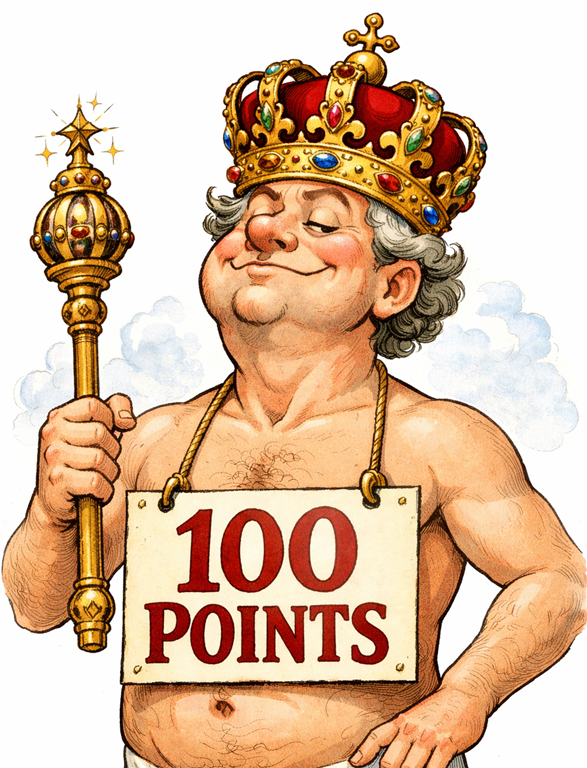
This is where the point system has done is its cultural work. The point system doesn’t merely describe quality; it creates an image of what quality is supposed to be. It teaches drinkers—especially new drinkers—that “the best” means the most technically flawless, the most consistent, the most reliably impressive on first encounter. If it receives 100 points, it must be the best.
Why? Why should we reward flawlessness and familiarity over expressiveness—over the excitement of experiencing something genuinely distinctive?
In most domains of craft and art, distinctiveness is a central virtue. We don’t give the highest praise to the novel that is impeccably written but interchangeable. We don’t celebrate the chef who can reproduce a perfect sauce if the meal never surprises, never finds a new register or refuses to take a risk in a quest for intensity. We admire technique, of course, but technique should be admired because it makes expression possible, not because it abolishes it.
Wine is strange in this regard. A certain kind of “intelligentsia” decided—over decades, with enormous market power—that the top reward should go to a style optimized for consistency and immediate impact: maximal ripeness, obvious oak signifiers, a plush midpalate, tannins groomed into submission. The wine becomes a product designed to dominate a short attention span. It announces itself loudly, then resolves into smoothness. Nothing left unresolved, nothing rough enough to snag your attention a second time.
This is why so many 95–100-point wines feel like they’re trying to eliminate the very qualities that make wine worth thinking about. Wine is not simply a beverage. It’s a living aesthetic object: a field of tensions, a play of forces, a moving target that changes with oxygen, temperature, glass, company, context, and time. The best wines aren’t “perfect.” They are expressive. They have edges. They have an inner drama—contrasts, countercurrents, moments of compression and release. They don’t just deliver fruit and polish; they deliver character.
On that score, the 100 pointers don’t measure up.
I can’t help thinking that this might be one reason younger people hesitate to get into wine. It’s not only the price, or the snobbery, or the health discourse, or the competition from cocktails and cannabis. It’s also the vibe: an inherited value system that tells them the pinnacle of wine is expensive uniformity, scored by authorities whose preferences hardened into doctrine.
If you’re a younger drinker and you taste “the best,” and it tastes like a more luxurious version of something you’ve already had, why would you be captivated? Why would you join a culture that seems to celebrate sameness with ever higher premiums? At some point you start to suspect the emperor has no clothes—not because the wine isn’t good, but because the criteria for greatness is too thin. A regime of value enforced by critics who happened to love opulent consistency, and who trained producers and consumers to mistake that for depth.
To be clear, this isn’t an argument against craftsmanship. It’s an argument for what craftsmanship is for. Craft without expressive risk becomes mere control. A wine can be flawlessly made and aesthetically inert. Inertness is not a sin; it’s just not what deserves the top of the mountain.
It’s time for that old paradigm to give way. Let’s make room for wines that are not merely polished but articulate. Wines that have torque. Wines that don’t sound like everyone else. Wines that feel a little dangerous in the glass because they haven’t been engineered to reassure you; they’ve been made to say something.
Give me the wild and untamed at the top of the list. Give me 100 points for new beginnings.
 Exploring the Philosophy of Food and Wine
I really appreciated reading this post. This is what I’ve believed and worked to implement through my over 50 years of grape growing/winemaking in California. Yes, the first rule for any wine is to taste good (obviously very personal and subjective), but beyone that it should have something to say ie reflect place, personality/personal taste of the winemaker and not be made to please critics. Too many cookie cutter wines, obviously made for a score, that all taste the same. Many years ago we (Peterson Winery) trademarked the slogan “Zero Manipulation”. Long winded, shaggy dog story why (it involves a Jackalope and a T shirt) but I got a fair amount of grief (mostly good nature ribbing) from fellow wine peeps. I telll people it is not a dogma but a philosophy and discipline. The fact that we don’t filter or fine our red wines does not, a priori, make them better or give them greater spiritual purity, but it does make them more interesting and closer to the vineyard that grew the grapes. The philosophy is that we don’t work backwards from how we want the wine to taste, but once we harvest the grapes we evaluate what that vintage gave us and adjust our traditional winemaking practices (open top fermenters, no additives (other than some SO2 to kill undesirable yeasts), punch downs, drain/press at 0 brix and use a basket press to create the most expressive and true to vineyard and vintage wine we can. I tell people we don’t try and make the same wine every year. Our consistency is we make wine from the same grapes/vineyards every year. I was fortunate to have worked with Dick Graff/Chalone when I was at Mt Eden (1979-1983). After I moved to Bradford Mountain/Dry Creek Valley and was waiting for the vineyard I planted to produce I was employed by Ridge as consulting vineyard manager (1985-1990) and worked with Paul Draper/Dave Bennion on the Montebello Vineyard. I love California mountain Cabs but sadly too many these days do not reflect the terroir of the site because alcohol, tannin, oak (and sadly sometimes sugar) overwhelm place. Thanks for the article and giving me a chance to vent. When up in Sonoma and have the time I would love to meet you, taste a few wines and continue this conversation.
Dead bang on!