
 Whenever we stumble upon a truth, we are quite likely making some other truth more obscure. We can never see everything whole, and shining a bright light on something by necessity creates shadows.
We tend to focus on geography, climate, and weather to explain the features of a wine but too often ignore culture. I suppose talking about land and weather appeals to us because they can be objectively described as inputs to the winemaking process. Their importance notwithstanding, we should not lose sight of the importance of culture in creating the taste of a wine.
When you taste a wine you’re tasting the result of countless decisions about what tastes good and what doesn’t, patterns of decision-making that often go back centuries. Decisions about what to plant, how to cultivate grapes, and what methods to use in the winery are driven by taste and taste is in part a social phenomenon influenced by the people around us and the education we receive from them.
When you drink French wine there is something of Proust, Debussy, and Monet in the glass even if you can’t quite put your finger on it or say what the connection is. (When you taste American wine is there something of Alice Cooper in the glass? Sorry. Bad example)
This connection between culture and flavor, ephemeral and vague though it may be, is lost when we taste blind. That is one reason why blind tasting, although a useful skill, is far from the epitome of wine appreciation. We don’t care only about the taste of the wine but the other associations that the wine conjures that gives those flavors and aromas dimension.
Trying to understand the import and meaning of a wine through blind tasting is like having a conversation by email—you get a message but is isn’t the whole message and the most important parts may be missed.
It may well be that a wine tastes differently when you know who produced it and how it was produced. Well, it should! Knowledge matters. You might enjoy a book even if you know nothing of the author or the context in which it was written but the enjoyment and your understanding will be limited.
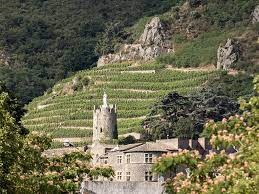
I adore the wines of Northern Rhone—or is it the precipitously steep, terraced riverbanks, dry stone walls, villages with cobblestone streets that still bear traces of Ancient Rome, the bouchons in and around Lyon, a rustic tartine savoyarde, or the music of Jean-Michel Jarre?
The question cannot be decided, a classically false dilemma.
 Exploring the Philosophy of Food and Wine
An excellent post, Dwight. While nature may determine soil and climate, it is the decades, hundreds, and even thousands of years of culture that determines what a winemaker does with those ingredients. And his/her decisions are based on history, culture and social interaction. Making wine in a region is very much like building a cathedral. Both need lots of people to work together, and both reflect the culture of the people involved.
Thank you Paul
Dwight,
Kermit Lynch’s periodic mailers do an excellent job of detailing the who, what, where and why of the wines he imports. Uncorking the wines completes the seduction.
Tom
indeed they do Tom. He’s quite aware of the culture of a wine.