
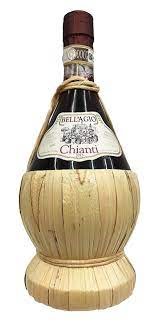
 For those who think wine doesn’t express meanings or function as a symbol, Maggie Hennessy’s article in VinePair “The Timeless Charm of Cheap Chianti” will disabuse you of that notion.
Every time I go to the Village, I happily suspend myself in gastronomic arrested development, to the tune of fried calamari, cups of minestrone, and heaps of spaghetti Bolognese. The same goes for the drinking side, in the 18-odd years I’ve been of age here. Never mind that Italian Village maintains an imposing wine cellar of 30,000-plus bottles, among which I assume one can find some formidable Chianti Riservas and Classicos. I wouldn’t know, because I’m far likelier to order Chianti in a grass skirt, also known as Banfi Winery’s Bell’Agio Chianti fiasco.
Why would a wine writer choose that much maligned symbol of Italian kitsch? (which frankly before the wine quality revolution tasted more like battery acid than wine.)
Someone with a “sophisticated” palate might say this wine tastes like cherries and leather, or passable red table wine, or maybe even cheap sh*t. (“You can drink something far better for a similar price!”) To me, middling Chianti is the drinkable incarnation of America’s platonic, if outdated, ideal of Italy. It’s red-checkered tablecloths, drippy candles, and Rosemary Clooney belting “Mambo Italiano.” It’s Audrey Hepburn in “Roman Holiday,” eating gelato in a cinched-waist dress and sandals or Michael Corleone on his first trip to Sicily in “The Godfather,” sipping nondescript table red from a little glass tumbler. Is it at least 80 percent Sangiovese? I don’t know or care; I’m only here for the fantasy.
It is not so much cheap Chianti that is charming; it’s the mode of life symbolized by cheap Chianti in a straw wrapper that has charm. Hennessy doesn’t provide much of an analysis of what it is about that way of life that is so alluring. She writes:
I’d find plenty of other means for propping up this fantasy. For instance, my steady diet of Martin Scorcese mobster films and Chicago-centric lore concerning John Dillinger and Al Capone. “The Sopranos,” which consumed six years of our collective attention in the early aughts and forever changed drama television, even reclaimed the title of HBO’s hottest show in April 2020, 13 years after its finale aired.
I have never thought of Al Capone or Tony Soprano as charming. YMMV.
No doubt Americans have long been fascinated by Italian culture and remain so. But what is it about “cheap-Chianti-culture” that fascinates?
I suspect it is the fact that everyday aesthetics is at the heart of it. Even in the gangster films, before and after the bullets fly, there is always the inordinate attention to sharing meals, reveling in the pleasures of ordinary life, not as passing moments but as moments to be pursued and savored, even when the fare is modest.
For harried Americans too busy to prepare even simple food with loving attention, such a life is aspirational. We have to settle for the images evoked by a bottle of Chianti wrapped in straw.
 Exploring the Philosophy of Food and Wine
Dwight,
Drinking wine from a tumbler (irrespective of its quality and provenance), is not an uncommon practice at Barras (aka Barchokas) household. It is, for me, loaded with meaning and symbolism. Lovely post. Thank You.
Tom
Well stated, Dwight! If you’re looking for the “experience” to be served to you, instead of making it yourself, it might be sadly costumed in a grass skirt or perhaps in a fancy chateau
Very well stated. The true measure of a good wine is whether or not you like it. The bottle may attract you at first, but the price may turn you off. Good wine is nothing more than what you enjoy.