
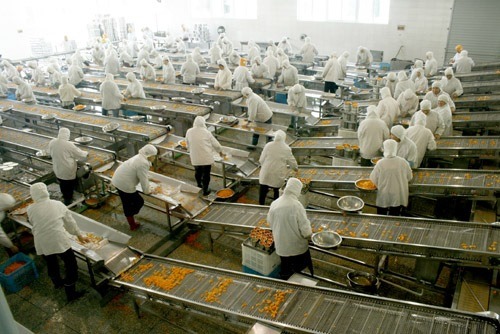
 As reports of Chipotle’s problems continue to make headlines, it may seem to you that the occurrence of outbreaks of food-borne disease that cover many states is increasing. According to this report in the Washington Monthly by Ann Kim you would be right:
From 2010 to 2014, the CDC reported 120 total multistate outbreaks, or an average of twenty-four per year. By comparison, from 1973 to 1980, the median annual number of multistate outbreaks was just 2.5.
So what’s going on? Is our food supply becoming unsafe?
Not necessarily. When compared to the amount of food produced, the amount of contamination is relatively small. Remember the outbreak of E. Coli in fresh spinach in 2006. As Kim reports, only 1000 lbs. of spinach was actually contaminated compared to the 587 million pounds of spinach consumed in in the U.S. that year. And the CDC is not reporting any overall rise in foodborne illnesses.
Matthew Wise, who leads the Outbreak Response Team for the CDC’s Division of Foodborne, Waterborne and Environmental Diseases, also notes that the overall number of foodborne illnesses hasn’t appreciably grown. What might be happening, he says, is that “the types of outbreaks might be shifting over time.”
And indeed that is the problem. What we are seeing is an increase in large, multistate outbreaks which are more lethal than local outbreaks:
According to an analysis by Samuel Crowe, an Epidemic Intelligence Service officer who works with Wise at the CDC, multistate outbreaks accounted for just 3 percent of total foodborne outbreaks over the past five years, but were responsible for 34 percent of hospitalizations (1,460 out of 4,247) and 56 percent of deaths (66 of 118). That’s because multistate outbreaks typically involve the most noxious pathogens—salmonella, listeria, and Shiga toxin-producing E. coli.
And the culprit? Industry consolidation of course. An industry that can efficiently deliver convenient, cheap food to the whole population can also efficiently deliver E. Coli.
“Consolidation has eliminated redundancies in the food system in the name of efficiency,” says Mary Hendrickson, assistant professor of rural sociology at the University of Missouri-Columbia. “But redundancies help protect us.”
In other words, if you have lots of small producers supplying local markets, a producer selling contaminated food will effect only a small, local population. By contrast a large, nationwide producer can spread contamination far and wide.
And our food supply is increasingly supplied by large firms. Take eggs for instance:
In 1969, according to a study by a group of CDC researchers led by Jeremy Sobel, the nation’s eggs were produced by 470,832 layer-hen farms with an average of 632 hens per farm. By 1992, the number of farms had dropped by 85 percent, while the average number of hens per farm increased by 470 percent, to nearly 3,000 hens per flock. Today, according to the American Egg Board, approximately sixty-three companies—each with flocks of one million hens or more—produce roughly 86 percent of the nation’s eggs. Seventeen of these companies, says the American Egg Board, have flocks of five million hens or more.
This trend towards large conglomerates is a industry-wide trend. When you go to the supermarket it looks like you have lots of choice. But in reality all those brands are created by the same large producers with different packaging for different markets.
I’ve argued repeatedly that consolidation in the wine business will harm quality and limit consumer choice. But consolidation in the food business seems to bring with it even greater harms. Efficiency is an important value, but it isn’t the only value; sometimes it can be positively dangerous.
 Exploring the Philosophy of Food and Wine
One comment