
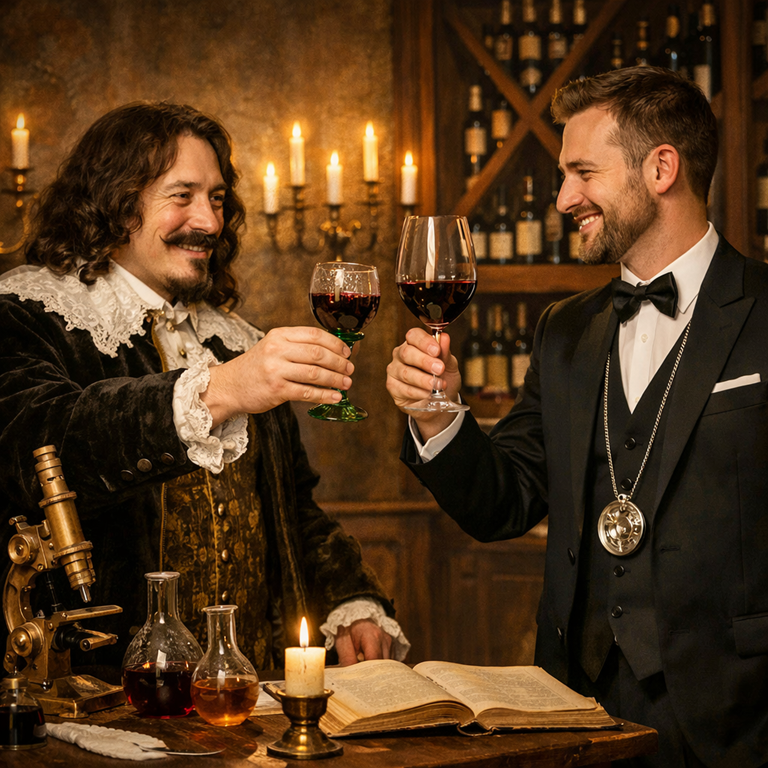
 Peter Pharos makes a fascinating observation about a parallel between scientific expertise and wine expertise.
As he points out, science once belonged largely to the well-off. Brahe, Lavoisier, Darwin, and even Newton all came from money or status. These early modern scientists were gentleman amateurs engaged in a refined pursuit for people with the time and means to indulge in it. However, by the early 20th century, that began to change as government and business saw that science produced practical benefits. As education expanded, more people entered the field and science became something else entirely. It was organized, professionalized, and built into the structure of modern states and their economies.
Writing about the public perception of science today, Peter writes:
Here is the funny thing though: the more successful science as a pursuit became, the less prestigious the profile of the scientist. The aristocratic enquirer gave way to the lone genius, who deferred to the inventive technocrat. But, in my lifetime at least, this had mutated to someone slightly, or even entirely, off.
Today, societies that depend heavily on scientific research often treat the people who pursue it as awkward, marginal, or faintly ridiculous, unless they take their expertise into the world of finance where their quantitative skill suddenly becomes glamorous. Here is where the parallel with wine expertise emerges:
Mirroring the science effect, the wine expert passes through the stage of an almost technocratic figure, providing interpretation and assessment, to a rather unsympathetic one. At best an insufferable bore, at worst, a conman. In the middle, as a vaguely malicious figure, the mythical wine snob. Either way, there is something off… For some reason, it [wine] seems to irritate an awful lot of people. Casting scientists as weird is usually born from jealousy and insecurity: the gnawing feeling that this is what intelligence actually looks like. Not dissimilarly, casting wine knowledge as wine snobbery seems, to me at least, to be rooted in some deep seated anxiety.
He then turns his ire on “credentialed turncoats” in the wine world, people with real knowledge who curry favor by joining the chorus against expertise. In that respect, they resemble scientists who lend their authority to industries whose profit motives corrode the norms of genuine scientific inquiry.
But I think the diatribe against sell-outs distracts from a more general point about expertise that is lurking in his post. After all, the fact that people sell out principles for money is as old as the hills. No new insight there.
The more important point is that both science and wine involve forms of esoteric knowledge that require training, patience, and cultivated judgment, and these are the kinds of achievements democratic cultures often struggle to honor. Democratization expands access; that is a good thing. But it also breeds entitlement: people come to feel that if something is open to them, its rewards should be immediately available as well. When that proves false—when science remains difficult or wine still requires education and attention—resentment emerges. Expertise then gets redescribed as fraud, elitism, or gatekeeping.
So both science and wine reveal a basic democratic tension: How do you make practices more inclusive without pretending that every difficult good can be had without discipline, apprenticeship, and the unequal achievements those demand?
In the age of “do your own research” I think it is a question democratic societies in general must answer.
 Exploring the Philosophy of Food and Wine