
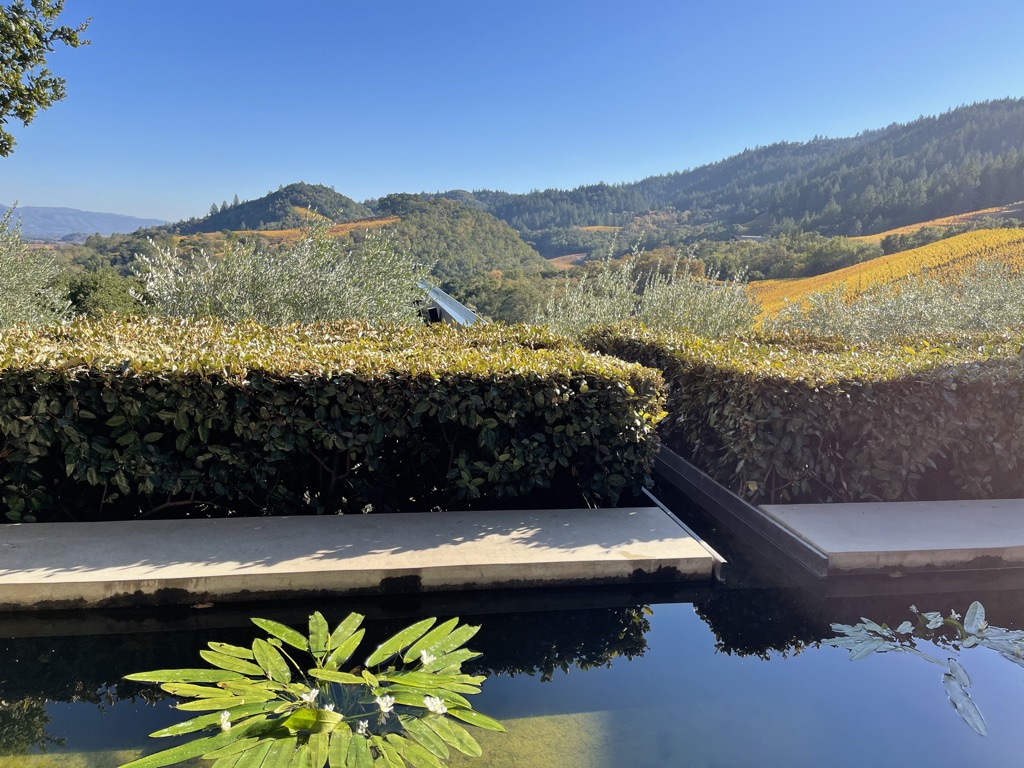
 I’ve been writing about wine for about 15 years and one of the most persistent themes I’ve covered is that winemaking should be considered an art form. But this has always been a tough sell, even among winemakers who often think of themselves as farmers rather than artists. This strikes me as a false dilemma. Why should it matter whether you’re using tractors and shears or a paintbrush to create aesthetic properties?
So I was very happy to read Adam Larchmere’s recent article in World of Fine Wine about Promontory Wines, a Napa Valley so called “cult cab” produced by Harlan Estates. I actually visited Promontory 2 years ago and found their wines to be a stunning exception to the popular image of Napa Cabernet as over-oaked fruit bombs. These are the most lifted, lively, minerally Napa Cabernets I have tasted. And the Harlan family is quite clear they consider winemaking an art.
In a recent interview, Bill Harlan articulated the winemaker’s desire for a wine to approach the condition of art. “If we can more purely express the character of the land, going beyond quality, […] we get closer to something that belongs to the realm of art,” he told Marvin Shanken of Wine Spectator.
In “going beyond quality,” of course, Harlan isn’t talking literally—at least, his customers would hope not. He is simply saying that the winemaker must be open to anything the land might suggest. He or she must not be beholden to any notion of what should be.
One of the most stubborn objections to the claim that winemaking is an art goes like this: artists control their materials; winemakers don’t. Painters decide where the line goes. Composers choose the notes in a melody. Winemakers, by contrast, are at the mercy of weather, soil, and biology. At best, they amplify what nature gives them. At worst, they manage the damage in a poor vintage. This objection has intuitive force, and I devote a good deal of space in my book to dismantling it. What struck me on reading the World of Fine Wine article on Promontory is how vividly the practice of viticulture itself already answers the objection—without ever needing to state it as a philosophical claim.
The article describes a site that seems almost designed to frustrate the fantasy of control. Promontory sits on fractured geology, with fault lines, mixed soil types, steep slopes, and exposures that change dramatically over short distances. Nothing about this land invites standardization. There is no “house recipe” that could simply be imposed. And yet, what emerges from encountering this difficult terrain is a different mode of control—one that looks remarkably like artistic practice.
The mistake behind the control objection is assuming that artistic control means domination. That artists begin with inert materials and impose a fully specified intention on them. But that picture fits very little actual art-making. Painters don’t control how oil paint dries. Sculptors don’t control the grain of marble. Jazz musicians don’t control what the room will sound like once bodies enter the space. In every serious art form, materials push back. They answer and often surprise us. Control, in these contexts, is not a matter of making commands but is about responsiveness.
This is exactly what the Promontory article documents. Vineyard decisions there are not about forcing uniformity but about reading difference. Relying on the early 20th Century British painter Lucian’s Freud’s comments on his creative process when painting a portrait, Larchmere writes:
Just as the artist channels the energy (“the aura”) of the sitter onto the canvas, so the winemaker channels the energy of the vine into the wine. “So much of the work is to map what you see on a vine to what you taste,” Empting says. “For me as a winemaker, it’s something that’s very visceral. If I see a vine that’s stressed, my mouth starts to dry out [as if] the tannins start to get a little bit more peaked. I’m tasting the vine as I’m looking at it.”
Blocks are farmed separately. Vine density varies. Canopy work responds to exposure rather than ideology. Even rootstock and clonal choices are adjusted parcel by parcel. These are not the gestures of someone surrendering agency. They are the gestures of someone exercising a refined, discriminating form of control exercised through attention rather than force.
And this matters because the objection to wine as art is not really about control in general. It’s about intentional control: the idea that artists can aim at aesthetic outcomes in a way winemakers supposedly cannot. But intention in the arts is rarely a fixed blueprint. It evolves through engagement with materials. A painter doesn’t know exactly what the finished canvas will look like when the first brushstroke in put on the canvas. Likewise, the Promontory team does not know exactly what the finished wine will be when pruning decisions are made in winter. What they have instead is something artists recognize immediately: a sensibility, a direction, a set of constraints within which discovery happens.
The article emphasizes how much of the work at Promontory involves what Randall Grahm once called “watchful waiting.” Waiting for vines to respond. Waiting for fermentations to reveal their character. Waiting for élevage to clarify structure rather than obscure it. This waiting is often cited as evidence of lack of control. But that gets things backwards. Waiting is how control is exercised when materials unfold over time. A composer waits to hear how a harmony resolves. A photographer waits for light. A winemaker waits for tannins to speak.
Importantly, Promontory’s restraint is not the absence of intervention. The winery makes countless decisions that shape the wine’s aesthetic character: harvest timing, fermentation management, extraction choices, aging vessels, blending strategies. None of these guarantee a result. But neither do artistic techniques in any medium. Control in art is always probabilistic. It is about increasing the likelihood that something expressive will emerge, not guaranteeing a predetermined outcome.
Seen this way, the contrast between art and winemaking collapses. Both involve materials with strong dispositional properties. Both require skill in reading those dispositions. Both involve intentions that become clearer through the process rather than prior to it. The Promontory article captures this beautifully by refusing to romanticize either nature or technique. Nature is not a benevolent muse. Technique is not a blunt instrument. What matters is their relation.
This is why treating winemaking as a mere amplification of what the grapes give you misses the point. Amplification implies passivity. What happens at Promontory is closer to interpretation. The land offers possibilities. The winemaker selects, emphasizes, restrains, and sometimes refuses them. That is not the absence of control. It is control operating at the right level of abstraction.
This intimacy extends to an almost anthropomorphic relation to the vines. “It’s a partnership,” Empting says. While conceding that “it’s important to know where you end and the vine begins” (we’re not in a John Wyndham novel, after all), his language is more akin to animal husbandry than conventional viticulture. “[The vine] shows you things and you respond, and there’s gratitude that’s given in different ways. That’s the key: You’re intervening, as if it’s a partnership. ‘I’m showing you that I can’t carry this cluster. Can you help me?’ And you do it. And then you see the vine say, ‘I can feel that my load’s been lightened.’”To make sure each vine gets the attention it needs, the Harlan team has developed the Vine Masters program, whereby vineyard workers—some with decades of experience—take full responsibility for a block, understanding the peculiarities of individual vines through the seasons.
If we insist that art requires total mastery over outcomes, we would have to disqualify much of modern art along with wine. Chance operations, improvisation, site-specific work, process art—all of these relinquish a fantasy of total control in favor of something richer: collaboration with materials and time. Promontory belongs squarely in this lineage. It shows that winemaking is not art despite its limits on control, but art because of how control is reimagined under those limits.
That, ultimately, is what the glass reveals. Not nature alone. Not technique alone. But a disciplined, patient intelligence working with a stubborn world.
 Exploring the Philosophy of Food and Wine