
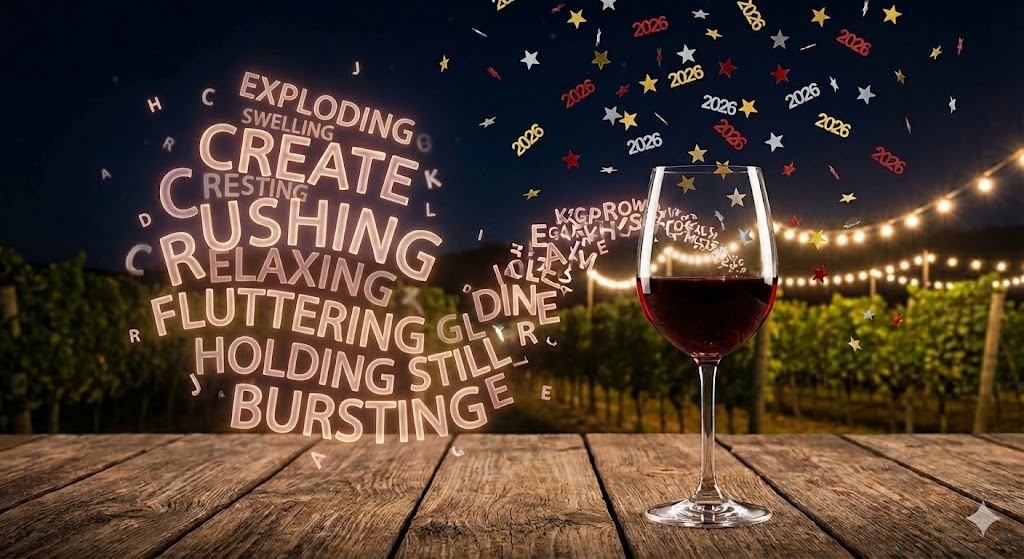
 It’s January, which means we are all briefly seized by the delusion that we can become better versions of ourselves by sheer declarative force. We buy notebooks. We swear off sugar. We download apps that will, apparently, manage our minds the way we (try to) manage our inbox. And because I am no better than anyone else (except perhaps in my willingness to overthink a glass of fermented grape juice), I have a New Year’s challenge too:
In 2026, I’m going to build a practical tasting model for expressive tasting—one you can actually use. (I wrote a book about this several years ago but never sat down to condense it into something usable that doesn’t require a degree in philosophy to understand.)
The problem I’m trying to solve is this: Most tasting notes read like an inventory. Blackberry. Cedar. Vanilla. Leather. “Fine-grained tannins.” “Long finish.” It’s not that these words are false. It’s that they’re mostly nouns—and wine is not a still life.
A wine isn’t a bundle of notes. It’s an event. It enters, expands, hesitates, tightens, fades and returns. It does things. And what we call “expressiveness” is about all that doing: the way the wine organizes time in the mouth, in the pressures and releases, in the little directional cues that make you want to savor rather than spit.
So my 2026 resolution is basically an attempt to get verbs back into tasting without becoming the person at the table who says things like “this Pinot is speaking its truth.” (Nobody wants that person. Least of all me.)
The hard part is that verbs arrive only when you ask the right questions.
Not “What does it smell like?” but:
- What is the wine doing right now? Is it opening, climbing, coasting, gripping, dissolving?
- What is driving the midpalate? Fruit sweetness? Acid tension? Tannin architecture? Alcoholic warmth?
- Where does the energy go? Does it move upward into aromatics, outward into breadth, or downward into bass notes—earth, bitterness, or phenolic drag?
- What changes after thirty seconds? Does it tighten as it breathes? Does it fall apart? Does it suddenly snap into focus?
- What’s the argument inside the wine? The push-and-pull: lift versus weight, gloss versus grain, generosity versus severity, clarity versus muddle..
- How does it end? Does the finish resolve like a cadence, or does it leave you with an open question?
When you ask those questions, the nouns become actors. “Blackberry” becomes a kind of pressure: plush or tart, swelling or pinned to the frame. “Oak” becomes a gesture—seasoning, framing, or smothering—telling a story about intentions. “Tannin” becomes not a property you list, but an activity—drawing edges, pulling the fruit back, pressing the palate into attention when they enter early.
That, at least, is the wager for 2026: a tasting model that helps us say not only what’s in the glass, but what the wine is doing—how it moves, how it persuades, where it resists, what it makes possible, and what all that means.
The best wines, like the best conversations, are the ones that make you want to ask more questions.
 Exploring the Philosophy of Food and Wine