
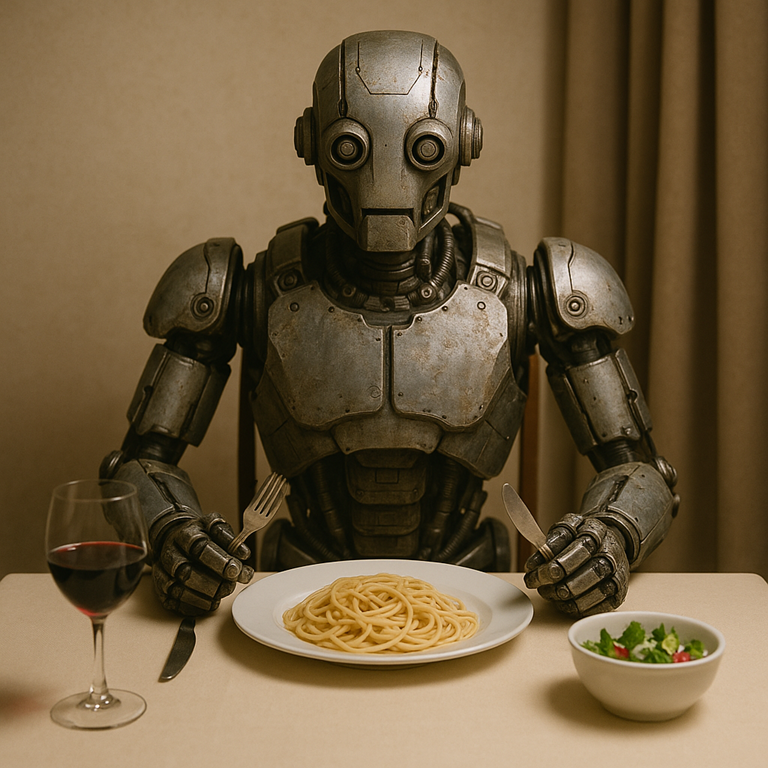
 This post piggybacks on my post earlier in the week about the plight of French winemakers as well as the post A Glass Against the Machine from several weeks ago. I am apparently obsessed with this idea.
I just finished watching an interview with Demis Hassabis, Google DeepMind’s CEO. He was extolling, among other things, the fact that we might soon be wearing Google Smart Glasses, an always-on AI assistant. He is very enthusiastic: “ While you’re cooking, it can advise you what to do next, whether you’ve chopped the thing correctly or fried the thing correctly.”
WTF. I’m supposed to want a daily assistant that critiques my knife skills and frying technique. Sure if I’m learning to cook. But I’ve been cooking for 50 years. I think I’ll pass. It seems to me he is utterly mistaken about cooking and the food revolution.
The food revolution started innocently enough. A curious palate. A splurge on Maldon salt. A sudden affection for really fresh vegetables and locally sourced meat. What began in the late 20th century as an indulgent curiosity about food has, in the 21st, become a cultural groundswell. We obsess. We document. We seek out sour cherries and obscure chili crisps like mystics hunting relics. But in a world gripped by ecological freefall, political grotesquerie, and now the steady infiltration of artificial intelligence into every crevice of daily life—why should food take on this strange, magnetic centrality?
Because food is still made by hands. And AI, for all its power, has no mouth.
The food revolution is not just about gastronomy. It is about reclaiming something impervious to simulation. As large language models, recommendation engines, and generative tools become the default interface between ourselves and the world, we find ourselves disoriented in a realm of infinite approximation. The algorithm knows what we want before we do. It finishes our sentences, chooses our playlists, corrects our grammar, and increasingly, predicts our cravings. But it cannot taste. It cannot touch. It cannot be nourished. In a world increasingly shaped by artificial intelligence, food remains stubbornly real.
It is this textured, ephemeral, embodied reality that makes food such a powerful site of resistance. Cooking for someone is not scalable. A meal, lovingly made, is not data. It cannot be optimized, A/B tested, or run through a productivity filter. The best meals are inefficient, improvisational, and just a little bit wasteful. They leave room for error, for whim, for care. They refuse the logic of the prompt.
We are living through the final colonization of the self: our inner lives mined for patterns, our preferences mapped, our creativity channeled through predictive engines. Even intimacy becomes a simulation, as AI-generated avatars coo to us on demand. The production paradigm that once governed the workplace now infiltrates the bedroom, the friend group, and the dinner table. There is no longer a border between private and public, human and machine, labor and leisure. Our attention is monetized, our expressions categorized, our boredom filled with endless content generated by models that know how to mimic pleasure.
And so the food revolution takes on new stakes. It is not just a celebration of flavor, but an aesthetic insurrection—a refusal to let the machine tell us what we desire. The sourdough starter, the backyard herb garden, the hyper-local pop-up run by one person with a vision are not only hobbies. They are gestures of rehumanization. They say: Here is something I made, by hand, for no reason other than that it tastes good and I wanted to share it.
In the age of AI, food is not just sustenance or luxury. It is proof of life. You must touch it, transform it, risk its failure. It grounds us in a reality no chatbot can simulate. And so, more than ever, the kitchen becomes sacred—not because it is nostalgic, but because it remains one of the last places where human presence matters.
To cook is to resist. To eat with care is to remember who we are. And to taste attentively and wastefully is to push back against the frictionless, placeless drift of the machine.
 Exploring the Philosophy of Food and Wine