
 A palimpsest is a manuscript on which the original writing has been erased to make room for new writing but of which traces of the original remain.
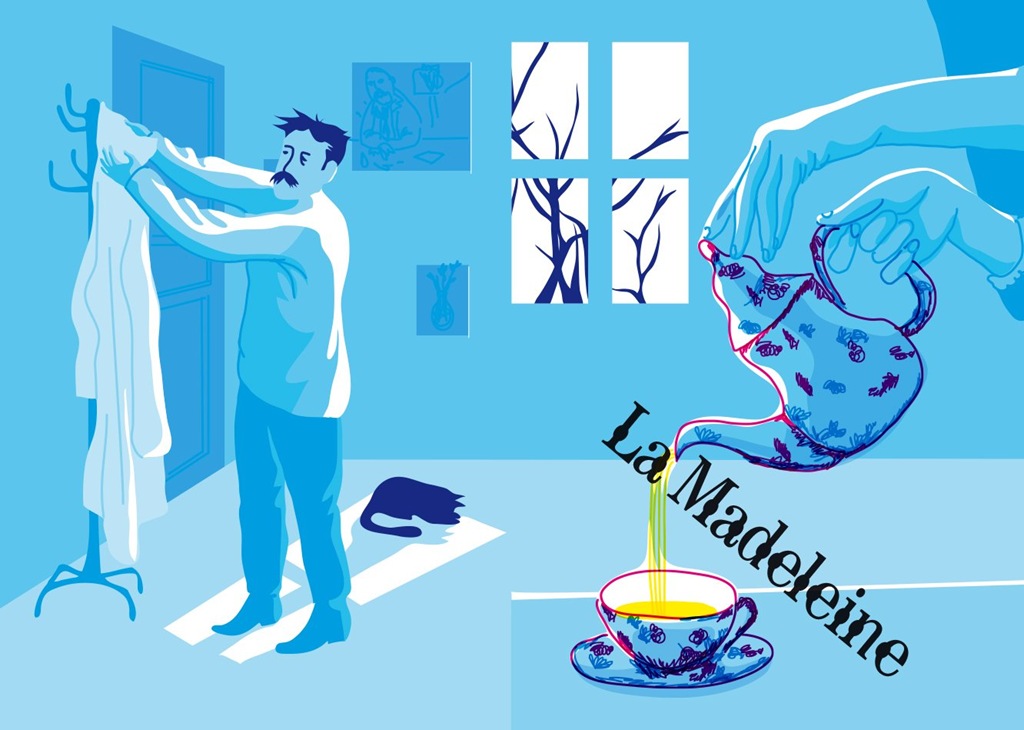
Food is like that. It is not merely nourishment but a layered archive, each bite writing upon the palimpsest of our past. This layering is most eloquently captured by Proust’s iconic madeleine moment in his novel In Search of Lost Time. As Marcel dips the crumb into lime-blossom tea, “a shudder ran through me… the taste was that of the little crumb of madeleine… and suddenly the memory revealed itself,” sending him back to his aunt’s bedroom and the streets of Combray. In that moment, the palate becomes both trigger and gateway—memory bursts forth involuntarily, not summoned by the mind’s will but by the senses’ insistent recall.
Contemporary science confirms this Proustian phenomenon. The so-called “Proust Effect” describes how odor and taste evoke autobiographical memory with unusual vividness, bringing more emotion and self-relevance than memories triggered by other sensory modalities.The brain’s gustatory and olfactory systems are wired directly into the amygdala and hippocampus, making taste an intimate conduit for emotion and recollection. A single spoonful of chicken broth can evoke childhood dinners, school lunches, travel moments, or longing for home.
But taste-memory is not a passive playback—it is transformative layering. Unlike a photograph or a painting, taste is ephemeral. The dish vanishes, but its echo lingers, becoming sedimented into new experiences. That is the palimpsest: traces overwritten and reactivated. Today’s miso soup might taste richer because of a remembered winter meal in Kyoto. This umami déjà vu doesn’t replicate; it refracts, colored by time. The past is rewritten even as it is recalled.
This temporal layering shapes not only our pleasure but our identity. These involuntary memories are not limited to tastes and smells; they recall events, people, relationships, or atmospheres .A recipe becomes cultural history. A single spice can conjure whole chapters of belonging, migration, care, or loss. Every mouthful is both present and past pulsing with affective resonance.
Phenomenologically, the capacity of taste to rewrite memory reveals the arrow of time traveling through flavor. We experience the present meal overlaid with fragments of what came before—ghosts of past meals, forgotten kitchens, and absent voices. That mouthful is both now and then situating the eater in a layered temporality, where taste erodes and inscribes, erases and preserves.
Recognizing this capacity of taste to recall and rewrite memory enriches both sensory and philosophical engagement. Taste becomes a site for investigating how memory, emotion, and temporality interweave. For writers and thinkers, that means attending to the aftertaste—not just the flavor, but the psychic echo. What does this dish remind us of, and what new associations does it inscribe? How does the body remember when the mind forgets?
Thus, the palate is not a blank slate receiving flavor—it is a palimpsest bearing the imprints of a lifetime. Each meal inscribes and enacts a dialogue between past and present. To taste is to remember; to remember is to taste across time. The simple act of eating becomes an archival encounter, and every morsel a rhythmic interplay of memory, embodiment, and unfolding narrative. In that ongoing script, the tongue knows.
 Exploring the Philosophy of Food and Wine