
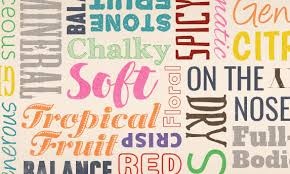
 We’ve all heard the complaint: wine is too complex, too nuanced, too transcendent. The sensory ballet performed in a glass of Burgundy is supposedly beyond the crude grasp of our pedestrian vocabularies. And so, wine writers sigh, defeated by language. “How could mere words possibly render this Pinot?”
Nonsense claims linguist Dariusz Galasinski writing for a South African wine publication.
Galasinski turns this familiar lament on its head. Of course language can describe wine—it’s just that most wine writers aren’t trying hard enough. After all, he claims, if Kant can describe the power and limits of human rationality and Baudelaire can summon the decay of modernity in verse, surely we can find a way to describe something as pedestrian (and as endlessly written about) as fermented grape juice. The problem isn’t linguistic inadequacy. It’s laziness, genre fatigue, and a chronic shortage of imagination.
Let me just point out before moving on that this is a silly argument. 240 years after Kant wrote his major works we are still trying to figure out what he meant. Language is never quite adequate to describe new ideas. And surely Baudelaire who famously wrote “You have to be always drunk. That’s all there is to it—it’s the only way” didn’t have the last word on the moral decay of modernity. What this has to do with whether wine can be described or not is beyond me.
But let’s see if the argument can be redeemed. He writes:
The key argument underpinning stories of wine writers’ difficulties is this: wine is so complex and so nuanced that rendering it in language is nigh impossible. It takes tremendous skill to discern wine complexity and so, it escapes language.
But he’s not having it. Yes, aroma terms can be inconsistent, and yes, modern societies don’t prioritize the olfactory. But that’s no excuse according to Galasinski. We have perfectly functional workarounds. “Smells like X” gets the job done. And let’s not forget that the sheer volume of tasting notes, blogs, and wine scores floating through the digital ether suggests language is doing something right.
So where does this myth of linguistic failure come from?
He identifies two culprits. First, the cynical take: some wine writers wrap themselves in an aura of mystique, implying that their insight is so rarefied, their palate so evolved, that no common words will suffice. It’s a rhetorical power move—less about elevating wine, more about elevating themselves. It’s not that they have nothing to say; it’s that the common folk wouldn’t understand it.
(I should note that he provides no examples of such writing or evidence that anyone holds this view. This seems to be pure speculation, little more than a gratuitous insult.)
Second, the more charitable view: wine writers are stuck on repeat. Rioja, Burgundy, Napa—they’ve been written to death. The real challenge isn’t describing wine, but finding something new to say about it. Which explains the turn to metaphor: wines become angelic, brooding, masculine, dignified. Such language is silly, he claims, but at least it’s alive.
In the end, the problem isn’t that wine defies language. The problem is that good wine writing is hard. And most wine writers aren’t failing because wine is ineffable. They’re failing because they’re playing it safe. So stop blaming the ineffability of wine. Write better. Say something worth reading. And please—no more seven-fruit salads with no verbs, he exclaims.
That’s the argument.
Jamie Goode wrote a sharp critique of this article taking issue with the claim that wine writing is hard because of wine’s complexity:
Who is saying that wine escapes language ‘because it takes tremendous skill to discern wine complexity’? Discerning wine complexity doesn’t take tremendous skill. Most drinkers can perceive this complexity. That’s not what we are talking about. And who is suggesting rendering wine in language is nigh impossible because wine is ‘so complex and nuanced’? Precisely no one. Some wines are simple, some wines are complex. Putting the perception of both into words is challenging because of that perilous journey from perception to language. It’s not because wine is special. Beer experts and whisky experts have the same challenge.
Jamie goes on to argue that wine is difficult to describe because we lack a vocabulary for describing aromas. He writes:
I’d argue that our lexicon for flavour is inadequate, which is why we have to make it up. And this is a task recognized in the literature as being challenging. One of the issues that bedevils attempts to capture smells and flavours in words is the difficulty we have naming them. We experience the sensation, but it seems incredibly difficult to put it into words.
I agree with Jamie’s critique but I want to expand on the reasons why wine resists description.
There’s a cleverness to this linguist’s attempte takedown of wine writers and their florid evasions—a certain academic satisfaction in watching a cherished myth get briskly dismantled. But beneath the wit and rhetorical flourish lies a curious blindness: a failure to grasp the very thing that makes wine so difficult to write about. Not its complexity, nor even its pretension, but its ephemerality.
Wine does not sit still. It moves—across the palate, across time, across contexts. It oxidizes, breathes, relaxes, tightens. It opens, closes, morphs in the glass. What you taste at minute one is not what you taste at minute ten. And what you notice at dinner—after the lamb and a pause in conversation—will not be what you find in a sterile tasting room at 10:00 a.m. on a Wednesday. To describe wine as if it were a stable object, like a sausage or a broomstick (the writer’s own examples), is to already mischaracterize it. It is to write as if what matters is captured once and for all—as if what we’re tasting isn’t in flux.
Language, for all its plasticity, is not built for the fugitive. It clings to nouns. It stabilizes. It prefers the representable, the repeatable, the nameable. When something disappears even as we try to describe it—when it shifts shape in response to warmth, glass, food, mood, or oxygen—language falters. Not because we are lazy. Not because we lack imagination. But because the tool is not perfectly suited to the task.
This is not to say wine writers are off the hook. Too much of the genre is inert and formulaic. But Galasinski’s insistence that “language describes wine just fine” misses the deeper problem. It presumes that language is a neutral medium, capable of transparently conveying experience if only we tried harder. But when the thing we are trying to capture resists fixity—when it refuses to hold still—language struggles.
The challenge of wine writing is not only stylistic or intellectual. It is ontological. You are describing something that is vanishing as you speak. This isn’t an excuse for bad writing. It’s a condition for taking the struggle to talk about wine seriously.
 Exploring the Philosophy of Food and Wine
As with wine, so with language. Language is not a stable, contextless, dictionary of words that we select from to describe a thing. It changes based on the medium through which it is instantiated (email versus music). It evolves as new people use it in new situations (do I have main character energy?). Its perception is modulated based on mood (don’t talk to me before my second cup of coffee). So often, it strikes me, the problem with simplistic critiques of wine writing is that they assume a simplistic understand of language. And so the problem space is confounded by two variables: both wine and language live, both are fugitive.
I enjoyed your post. Thank you.