
 At first glance, this question seems fanciful— the kind of romantic flourish found in the waxy prose on wine labels. Surely, wine cannot be alive in the strict biological sense: it doesn’t grow by cell division, cannot reproduce, and shows no capacity for Darwinian evolution. Yet, the intuition that wine is somehow alive refuses to die. Why?
Let’s start with the basics. Biologists often define life through a checklist: cellular structure, metabolism, growth, adaptation, homeostasis, response to stimuli, and reproduction. Wine fails on several of these conditions. No cells are dividing in your bottle of Bordeaux. No baby Merlots emerging from your aged Syrah. If life were a club with bouncers enforcing strict entry rules, wine wouldn’t even get past the velvet rope.
But these definitions aren’t as airtight as they seem. Mules, worker bees, the elderly, and the last rabbit on Earth all remain incontrovertibly alive despite being incapable of reproduction. Viruses, meanwhile, lack a metabolism and can’t reproduce on their own, yet we hesitate to call them inanimate. Even on Earth, life defies easy categorization.
If reproduction isn’t a necessary condition for life, perhaps metabolism is. This seems more promising. Metabolism, the set of chemical processes that sustain life by converting energy and matter, is more central to our intuitions about what it means to be alive. Here, things get interesting.
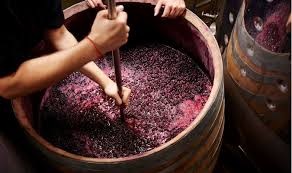
Wine begins life (if we may say so) through fermentation, which is a metabolic process—but not the wine’s own. Yeast, a living organism, metabolizes sugar into alcohol and carbon dioxide. Once the yeast dies and settles, however, we’re left with the wine itself, bereft of any active cells. But that is not the end of the process.
What happens after fermentation, especially in red wines, is a chemistry of building structure. Tannins bind with oxygen and color molecules, forming colloidal structures that soften the wine’s texture. They stabilize its aromas, and most importantly protect it from oxidation. These reactions aren’t biological metabolism, strictly speaking—no cells are coordinating energy use—but they mimic metabolic functions: building structure, resisting entropy, and responding to environmental inputs like oxygen and temperature.
Wine, in other words, undergoes pseudo-metabolic development. It has an internal chemistry that enables it to change, maintain structure, and defend against degradation—all hallmarks of life.
Wine doesn’t just sit still once the fermentation ends. It moves—slowly, subtly—but it moves. It shifts. Over time, it changes in ways that are hard to predict and harder still to fully control. Like Heraclitus said of his river, it is never the same each time you step in it.
That may be just poetic fancy, but there is a line of thought worth following here. Some biologists and philosophers have tried to rethink what it means to be alive. Called Living Systems Theory, instead of focusing on whether something has cells or can reproduce on its own, this theory looks at patterns of organization. Feedback loops. The exchange of energy and information between a thing and its surroundings. Systems that maintain their own structure—not forever, but long enough to matter.
If you look at wine from that angle, it starts to seem not quite alive, maybe, but not lifeless either. A vineyard isn’t just a field of plants. It’s a teeming, interdependent world—soil, fungi, insects, weather, human care. Grapes don’t just grow; they’re shaped by hands, machines, sunlight, and chance. And once picked, crushed, and coaxed into wine, that liquid carries forward something of its origin—something you can taste, argue about, even try to replicate.
Winemakers do this every year. They don’t clone the wine, but they do remake it. A vintage isn’t just bottled chemistry; it’s a memory, a decision, a reaction to the last time. Critics weigh in. Drinkers vote with their wallets or their words. The next bottle is made with all of that in mind.
So wine is alive, not because it checks off biological criteria, but because it participates in a self-organizing, evolving system. It “metabolizes” not just sugars and tannins but tradition, human intention, and environmental feedback.
To declare that wine is alive, then, is not to deny science but to stretch its definitions to meet the richness of lived experience. Wine resists stasis, develops complexity over time, integrates with its surroundings, and carries the imprint of its makers and its place. Living things have the capacity to resist entropy through organization. They engage in meaningful transformation. They harbor the seeds of the future in the structures of the present. So does wine—and so according to living systems theory it belongs in the grand theater of life.
Perhaps that’s why we age it, study it, cherish it—not just as a drink, but as a process, a personality, and as something in the process of becoming.
 Exploring the Philosophy of Food and Wine