
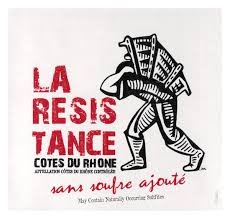
 Jason Wilson asks a very important question as we sit in front of our screens watching civilization unravel with very little we, as individuals, can do about it:
“Can drinking wine be a form of resistance?”
He concludes:
For those of us who see fine wine as an element of the good life, perhaps we are all trying to quixotically keep alive whatever “faint glimmers of civilization” are left in our tech-dominated age. My nagging fear is that we are already too late.
At first blush the absurdity of the question answers itself. But the idea is not new. As he points out, the various advocates of romanticism in the late 18th and early 19th Century were convinced that emotional expression, originality, folklore, and belief in the supernatural were antidotes to what they perceived as the excessive rationalism of the Enlightenment, exemplified in the increasing industrialization and mechanization of life that severed humanity from nature.
The idea that wine—at least the small-batch, artisanal, terroir-driven wines many of us drink—might deepen our connection to a vision of life less violent, less bigoted, and less rapacious than the life being foisted upon us is not crazy; it’s not even wrong. I find myself with the same thoughts. Whatever helps us survive psychologically is a central part of the resistance (whatever that turns out to be.)
So Wilson advocates a return to romanticism rejecting the empiricism “that reigned for a significant part of this century” and seeking a backlash against the holy algorithm “similar to the original 19th century Romantics who pushed back against the Industrial Revolution—Luddites burning down factories and artists declaring war against the principles of the Age of Reason.”
While I wholeheartedly endorse what he calls romantic wine criticism, a mode of criticism more generous and less critical that helps the reader enjoy a wine by exploring its many dimensions, I think the general endorsement of Romanticism misfires in much the same way the earlier romanticism misfired.
The problems the earlier Romantics railed against, for which they blamed rationalism and empiricism, were caused by the exploitation of workers, colonialism, the forcing of peasants off rural lands to be housed in city slums with poor sanitation, and unregulated capitalism which created boom and bust cycles that left mass unemployment and starvation in their wake. These were the very conditions Enlightenment thinkers and empiricists were trying to alleviate. The problem wasn’t philosophy but garden variety greed and hatred unleashed from the physical and ideological constraints of the past. And so the Romantics, despite their passion and lyricism, threw the baby out with the bath water succumbing to grotesque superstitions and fueling militant nationalism the consequences of which we still suffer.
Today it’s hard to see the predations and cruelty of modern fascism as anything but pure nihilism. There is nothing empirical about it as they flush the edifice of modern science down the toilet.
And there are other targets of Wilson’s wrath: “Wellness culture—and the neo-prohibitionist movement that has sprung from it—must also face this Romantic backlash.”
The nostrums of “wellness culture” an example of empiricism? Please. The neo-prohibitionist movement persists in ignoring science when it’s inconvenient for their ideology.
What wine offers is not a respite from technology or science. The best winemakers I know are thoroughly empirical, proceeding via careful observation and incessant testing and experiment, all supported by a thorough knowledge of the science of winemaking and viticulture. What they also understand is that winemaking isn’t reducible to a formula.
Instead, wine offers resistance to what I call the Production Paradigm—the idea that more is always better, growth must be constant, and the measure of individual worth is how efficiently we produce. Modern human beings are the new hamsters frantically climbing a ladder that leads only to more ladders on a spinning wheel that does little but boost someone else’s bank account. In our current debacle, our overlords have decided to kill off the hamsters since the wheel is now self-propelling.
Wine like other sources of beauty is a form of resistance because it is an activity of pure surplus. It serves no other purpose but enjoyment, awe, or wonder. When we savor wine we are nobody’s instrument and efficiency does not get a grip on us. The Romantics to their credit knew this but chose to battle the machines instead of the human heart where nihilism unfortunately thrives.
 Exploring the Philosophy of Food and Wine