
 Curnonsky (the pen name of Maurice Edmond Sailland) was called the prince of gastronomy when he was extolling the virtues of French country-style cooking in the early 20th Century. He was known for his aphorisms as well as his prodigious appetite. Perhaps his most famous quote is still regarded today as a fount of wisdom: “Good cooking is when things taste of what they are.”
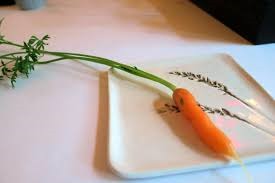
I’ve seen countless chefs mention this as a guiding principle. Perhaps it is no better exemplified than at Dan Barber’s restaurant Blue Hill at Stone Barns just north of New York City, where their signature dish is a single raw carrot grown and harvested in their garden.
I have not had the opportunity to eat at Blue Hill but I am sure this is a wonderful carrot. Indeed, there is something special about unadorned ingredients when they are remarkably flavorful.
But as a general principle of cooking, Curnonsky’s quote is nonsense. This is in part because most chefs most of the time are not working with ingredients that are at their peak. For most vegetables, there is a very short window after harvest before the flavor begins to decline. Some chefs will go to considerable trouble to use such ingredients but they are the exception rather than the rule and, in any case, there is neither time nor money to guarantee all ingredients are invariably at peak flavor. The norm even in fine dining establishments is to use ingredients that are good but only occasionally exceptional.
But these special cases aside, the job of a chef is to transform, not make things taste of what they are. The very act of cooking profoundly transforms flavor often by adding flavors such as caramelization or charred flavors that were not present in a raw state. Although salt and sugar are used to enhance natural flavors, and some ingredients can bring out muted flavors in an ingredient, most spices and all sauces are used to create new or emergent flavors in the ingredient around which the dish is composed. When ingredients are mixed together as in stews, soups, sauces, or braises the idea is to modify the flavor of the basic ingredients, not to taste of what they are. Moles and curries may have 20-30 ingredients in them. At the end of cooking which of them tastes of what they are?
Consider three artists all of whom paint the very same landscape from the very same perspective. Suppose they have as their aim to get everything in the landscape in exactly the proper spatial position, to capture the light exactly as it appears while they paint, and to use colors that precisely match the colors of the objects in the painting. In other words, they aim to make the painting look exactly like their subject. Why would these paintings be of any interest? Each painting may differ slightly from the others because each artist has their own technical skills and may see things differently. But they will largely be without interest from an aesthetic point of view. We expect more from art, even representational art, namely a painter’s distinctive point of view and a way of looking at the landscape that might not be available to a casual observer. If the goal was to render the object just as it is, we should dispense with the painting and just view the landscape.
Now consider three roast chickens each cooked by a different chef but with the aim to make them taste like chicken and nothing more. If competently prepared, they would make a perfectly fine meal but there would be nothing aesthetically remarkable about them and certainly not worth the hefty price of a restaurant meal. We want the chef’s perspective on roast chicken, not the farmer’s perspective on a well-raised chicken.
Curnonsky hated the fancy cooking in the grand style exemplified by celebrity chefs such as Carême. Fine. But you should not allow your enemies to goad you into speaking nonsense.
 Exploring the Philosophy of Food and Wine