
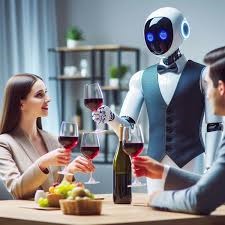
 Philosopher Barry Smith, director of the Centre for the Study of the Senses, says probably not, in his recent wide ranging essay in World of Fine Wine.
Of course we can’t rule it out given the remarkable advances in machine learning and large language models but there is reason to be skeptical. As Smith points out, “smell, taste, and touch are missing from our lives online.” You can see the bottle on your screen and hear the pop of the cork but you won’t find those aromas wafting from your keyboard.
But is there reason to think the chemical senses are in principle impossible to represent digitally? Isn’t it just a technical limitation corrected by more computing power, bigger datasets, or better algorithms? Again Smith is skeptical.
An experience of tasting requires us to put real liquids in real mouths, just as smelling requires putting real odorants up real noses. You might bolt on a delivery device to the VR headset that puffs wine aromas to the nose and squirts drops of liquid onto the tongue, but this still requires real odorants and liquids contacting real noses and tongues. Why go to the trouble of orchestrating real sensory experiences like these with what we see and hear via the headset when we could just give people a glass of wine?
Well, I could imagine online retailers providing “aroma samples” of the wines they sell. There would have to be some sort of chemical emission device attached to your computer that could be triggered by digital code. Impractical and expensive to be sure. But the question isn’t about practicality but whether it is theoretically possible. But Smith notes:
“And for there to be virtual aromas coming from the virtual glass, there would have to be a computer-generated entity causing you to smell it. But what sense could we make of a computer-generated aroma? Would a digitally created rose smell as sweet?”
This is the right question to ask. No doubt wine is a collection of chemicals. But it is the arrangement of those chemicals that makes wine taste like wine. And there is a strong argument to be made that the process by which that arrangement came about—viticulture and fermentation—matters in how the final product tastes or smells.
Let’s put this question of tasting a digital representation of wine aside. Perhaps AI cannot directly represent aromas or flavors. But it can surely represent language about aroma and flavors. Might we be able to use AI to provide descriptions of what a wine tastes like based on its chemical structure by summarizing data? In other words, could AI replace wine reviewers and others who report on what a wine tastes like by using tasting notes as the data set? Smith reports on an attempt by perfumers to match individual aroma molecules with descriptions of how those molecules smell.
Machine learning enabled the model to associate perfumers’ odor descriptions with vector representations for odor molecules starting from a training set curated from perfumers’ descriptions of more than 5,000 single molecules. Not only did the model recapitulate the odor labels the perfumers gave to these molecules, it could also extrapolate to new cases—specially created odor molecules that a trained human panel sniffed and labeled.
AI cannot smell. But it collates linguistic data from humans who do smell and report what they’re smelling.
But as Smith points out, the perfumers were associating aroma descriptions with individual molecules. Wine aromas consist of hundreds of molecules that interact in unpredictable ways. Aromatic mixtures are not simply a matter of adding up individual aroma notes. But more importantly, linguistic descriptions are a poor substitute for tasting the real thing.
What we find in the training set and the outputs are labels that practicing perfumers use to describe a molecule’s odor quality. Do such labels equip us to know how a molecule smells? If I tell you a given molecule smells creamy, floral, ethereal, and green, do you now know how it smells? I suspect not. Similar considerations apply to the tasting notes wine professionals use to convey how a wine tastes. As I argued in a previous issue of this title, a sip (or a sniff) is worth a thousand words.
In any case there is no reason to think deep learning models or linguistic prediction devices like LLM’s latch on to the same features of a wine that human tasters so. But who knows? As Smith points out we really don’t know how Large Language Models generate their predictions.
It’s often pointed out by philosophers that taste and aroma have been historically ignored by theorists interested in the senses. They have long been treated taste and smell as less important to human survival and less interesting with regard to our understanding of how the brain works when compared to vision or audition. But taste and smell may be the senses most resistant to being digitally represented and most representative of the animal in us all.
 Exploring the Philosophy of Food and Wine
One comment