
 The headline of this article by Dave Macintyre says it all
Biodynamic wine has roots in pseudoscience, but the proof is in the bottle
Dave Macintyre, wine columnist for the Washington Post, is no wide eyed spiritualist, back to nature hippy, or natural wine guru. So when he endorses biodynamic farming it’s because he’s observed the difference it makes.
Nobody quite knows why biodynamic farming works but some of the most highly respected wine growers in the world have spent enormous sums converting their vineyards to biodynamics.
Biodynamic farming was invented by an Austrian philosopher Rudolph Steiner in the 1920’s. Its general principles seem sound enough. Synthetic fertilizers and insecticides harm the land so only natural products should be used to keep the soil healthy. On the surface this is not all that different from organic farming. Steiner also argued that the farm is its own ecosystem. And of course it is. Paying attention to unique ecological relationships in each vineyard seems like a good way to avoid problems. But Steiner’s “spiritual science” takes matters a bit too far.
Fertilizers and treatments for crops should be natural and drawn from within the farm, rather than using synthetics from outside. Planting and harvesting should be timed to take advantage of the gravitational effects of the sun and moon….Because of those aspects, biodynamics has been ridiculed as pseudoscience, voodoo agriculture and several unprintable descriptions. Its most famous “preparation” involves stuffing cow horns with manure and burying them throughout the farm in the fall, then digging them up in the spring to make a tisane — a not-exactly-herbal tea — to spray on the crops to promote vigor. Other preparations use chamomile and stinging nettle. The biodynamic calendar, with its reliance on the phases of the moon and root, flower, leaf and fruit days according to where the moon is in the zodiac, conjures images of hippie communes.
But if Romanee-Conti, Château Palmer, and Château Pontet-Canet, all biodynamic producers, are on board, there must be something to it.
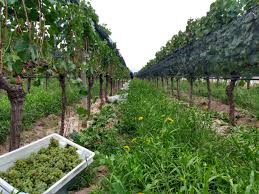
Maybe it’s the cover crops between the vines. Laurent Montalieu of Oregon’s NW Wine Co, who is featured in the story thinks the biodynamic practices make the soil less compact so the root system can go deeper.
Whatever the explanation, it seems to produce healthy grapes. And many biodynamic winegrowers ignore the metaphysical nonsense while using those practices that produce good results. Winegrowers are nothing if not empirical.They continuously observe, experiment, and observe again to test the results. And the results are difficult to deny.
in 2022 Jancis Robinson reported that 4,476 acres of vineyards in the U.S. have the Demeter certification, the organization which certifies vineyards as genuinely biodynamic. But the use of biodynamics is much more widespread than that number would indicate. Many wineries use the techniques but don’t bother with the certification which is very expensive and time consuming.
And biodynamics apparently can scale up. Chile’s Emiliana Vineyards, the world’s largest biodynamic vineyard has 1600 certified acres under vine.
It’s not easy to grow biodynamically. It requires patience, knowledge, and ingenuity since every vineyard responds differently to the treatments. It isn’t for everyone but its promoters are passionate and they seem to have the receipts.
 Exploring the Philosophy of Food and Wine