
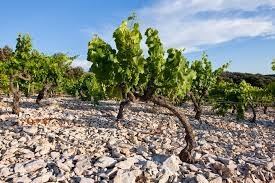
 The claim that terroir is an illusion used to be bandied about with some regularity. Thankfully, it seems to have receded as a topic of discussion. It’s obvious, if you drink widely and thoughtfully, that wine grapes are extraordinarily sensitive to differences is weather, geography, and soil composition and those differences show up in the glass. Now we have more rigorous confirmation from an unlikely source:
Fraudsters who pass off ropey plonk as a high-end tipple may soon have artificial intelligence on their case; scientists have trained an algorithm to trace wines to their origins based on routine chemical analyses.
Researchers used machine learning to distinguish wines based on subtle differences in the concentrations of scores of compounds, allowing them to track the wines back not only to a particular vine-growing region, but to the estate where the wine was made.
Using gas chromatography to identify compounds in each wine, researchers analyzed 80 wines over 12 vintages from 7 Bordeaux estates and collated the data using machine learning to show that wine from each Chateaux had a unique chemical signature. Although fraud detection was the goal driving this research, this technology will obviously change the way final blends are made, especially for wineries seeking consistency from vintage to vintage.
This got me thinking about the conundrum the wine industry faces. The variations from terroir are wines’ biggest selling point. It is what makes wine distinctive as a beverage. But most casual consumers don’t care because they lack the training and experience to notice those differences. This is why wine education is so important for the industry but it takes a lot of education and dedication to learn to taste these variations and relatively few are willing to take that journey.
It’s nice to know that the glass you’re drinking is distinctive and original but if you can’t taste what makes it distinctive and original the pleasure is limited.
I have no idea what the solution to the conundrum is but perhaps more agile minds will figure it out.
On that note we can use a little “hopium” from Mike Veseth, The Wine Economist. When he looks at the program for the first Unified Wine Symposium held in 1990, he notes people in the wine industry had the same concerns they have today.
Looking back at the program for the first Unified, it is clear that the American wine industry was worried about the future. It must have seemed like obstacles and headwinds were all around. Problems in the vineyards. Rising foreign competition. And concerns about both government regulation and uncertain consumer demand. One session was titled “Who Isn’t Drinking Wine and Why.” That’s a question we are asking again today.
The good news is that no one at the time knew we were about to enter wines’ golden age. That isn’t something you can see coming; you can only recognize it after the fact. So he closes with this:
I wonder what’s ahead for wine? My friend Kenneth Boulding used to say that history doesn’t repeat itself, but sometimes it stutters. Something to think about! Another golden age? Hard to see how the stars could align to make that happen. But I don’t think many people saw that golden age on the horizon either.
 Exploring the Philosophy of Food and Wine
You say: “The variations from terroir are wines’ biggest selling point. It is what makes wine distinctive as a beverage. But most casual consumers don’t care because they lack the training and experience to notice those differences.”
It’s not just casual consumers. If there is one thing that we learned from the tasting in Paris in 1976, it’s that even experts can’t detect even the broadest differences–such as the supposed differences between Napa and Bordeaux. And this was true even after they retasted the wines six months later, knowing that both types of wines were included. The expert panel simply couldn’t distinguish between the wines of the two regions. Emile Peynaud explained that he could not distinguish the wines of the various communes of Bordeaux–and was amazed at those experts who claimed they could.
The differences in terroir are always secondary to the influence of the hand of the winemaker, as can be shown by any tasting of the same vineyard designated wines from different winemakers. That is also appropriate in any discussion of wine as art-as it reflects the hand of the artist. And yet the wine industry continues to promulgate the grand myth of terroir being the be-all and end-all of fine wine. It’s not. And not even experts can identify it in a truly blind tasting.
I have judged at the Concours Mondiale a few times, and every time I was struck by the fact that top judges, when confronted with a group of wines that could literally come from anywhere on the planet, made from any grape in the world, usually wandered clueless in the wilderness. If that is the case, then terroir must be missing in action.
And yet the wine industry teaches us all that we should be able to do this, even when evidence is clear that experts cannot.