
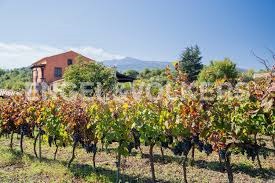
 One of wines’ singular virtues is that it takes us to a place, a plot of land, a people, and their struggles and triumphs, all in the name of tasting good.
Of all the places in the world that grow wine, Italy may best exemplify this virtue.
The learning that accumulates over several thousand years of viticulture have produced varietals well matched to their local soils. From the modest, cultivated hills of Piemonte through the plain of the Po Valley, the rugged Pollino Mountains in Calabria, to the foothills of Mt. Etna, every little village, indeed many village trattoria have their own vines, in some cases their own varietals, and their own techniques of winemaking. There are 350 authorized grape varieties grown in Italy and who knows how many unauthorized varieties, hybrids, clones, etc. The house wine at a trattoria may be as distinctive as anything you find at a wine shop.
However, Italy’s commitment to localism is wrapped in a paradox. There is a distinction to be made between the well-trodden wine roads of Tuscany and increasingly Barolo or Veneto on the one hand and the less traveled slopes of Calabria or Umbria on the other. It is a peculiar modern notion of “local” in which the hallowed ground is overrun by tourists and the locals spend most of their time and energy catering to universal needs in an international market that increasing influences the local flavors. Localism is an idea, a romance, whittled, pared down and tightly bound to the flow of finance.
Yet despite this colonization of indigenous taste, the land and the sun manage to produce something that remains distinctive. The Italian spirit seems inherently to seek its own way even as it keeps one eye on global trends.
In the modern world nothing is truly local and it’s delusional to think that old world could return. But soil and weather haven’t gotten the message. If there are enough people who are content to let nature run its course, we might still be justified in finding inspiration in some anonymous small parcel of real estate that produces a singular, irreducible beauty.
 Exploring the Philosophy of Food and Wine
I’ve mostly stuck to Tuscany and Barolo when it comes to Italian wines but now I’m so curious about what lesser-known regions like Calabria or Umbria have to offer. It’s exciting to think how much more there is to discover beyond the classics! Thanks for sharing!