
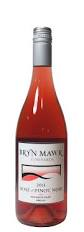
 It’s December. Half the country is in a deep freeze. Why am I writing about Rosé, a style of wine associated with summer days at the beach? Because we drink white wines throughout the year when we want something light and refreshing—why not a good Rosé? In fact, the essential difference between white wine and Rosé is that the Rosé has some skin contact to provide the pink color while most white wine juice is separated from the skins before extracting color. (Most wine grapes have white flesh; it is maceration on the skins that give red wines their color)
In theory, Rosé can be just as interesting as white wines. The problem is that most Rosés (including so-called pink or blush wines) especially in the U.S. are made as mass-produced, bulk wines with lots of residual sugar. They tend to be boring and innocuous, more like soda than wine. In the not-too- distant past you would have to look to the south of France to find good Rosé. But this is changing as some U.S producers are taking this style more seriously. Bryn Mawr, a producer of excellent Pinot Noir, is one example of a producer who sets aside some of their grapes each year to make a fine Rosé.
I look for Rosé that is crisp and bone dry but with a little weight on the palate and sufficiently intense fruit aromas to give it depth and interest . This one fits that description.
Enticing notes of pear, rose petal and raspberry aromas are joined by hints of orange peel on the flavorful palate all wrapped in vibrant acidity with a lengthy, mineral finish. Aged on the lees for 5 months, this Rosé has surprising flesh and dimension.
Most Rosés, even the serious ones, are made as a by-product of making red wine. In the process of making the a full-bodied red, some juice is bled off the skins after a short maceration to make the remaining wine more concentrated, and that “bled” juice is used to make Rosé. It is a way to use juice that would otherwise be discarded. By contrast, Bryn Mawr makes “intentional” Rosé. The grapes are harvested specifically to make Rosé, meaning they are harvested at a lower brix level to preserve acidity. Using a combination of de-stemmed and whole-cluster berries, the grapes are directly pressed to produce the wine and the juice is then fermented in neutral oak barrels, and as noted rests on the lees (dead yeast cells) for 5 months.
This level of care is apparent. The Bryn Mawr is as good as Rosé gets.
Score: 90
Price: $20
Alc: 12.9
 Exploring the Philosophy of Food and Wine