
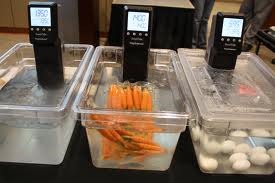
 Traditional cooking techniques kill pathogens in food by blasting the exterior of the food with heat, eventually raising the internal temperature to the pasteurization point. The result is an exterior that is usually overcooked.The challenge has been to find a way to precisely hold low cooking temperatures over an extended period of time, and to find an efficient way of transferring heat to food so cooking times are reasonable.
Sous Vide cooking (the French term for cooking in a vacuum) solves both problems by holding food at the pasteurization temperature instead of blasting it with excess heat, killing pathogens without overcooking the food. The result is an exterior that is as tender and moist as the interior. Furthermore, it is impossible to overcook the food since it never gets higher than your target temperature.
The problem is real sous vide cooking, as performed in restaurants, requires lots of expensive equipment. But there are some do-it-yourself methods that require only ordinary household items—I’ve tried them and they work reasonably well without too much fuss or extra work. Even non-geeks, luddites, and technophobes can manage.
Here is a website that gives you a blow-by-blow description of how to do it.
 Exploring the Philosophy of Food and Wine