
Most art theorists have argued, following Kant, that artifacts are genuine works of fine art only if they have intrinsic value—they must be designed strictly for aesthetic contemplation, and cannot be an instrument to serve some other purpose.Thus, cooking could not be a fine art because it serves a purpose, the satisfaction of hunger, rather than aesthetic contemplation alone.
I have argued in earlier posts that the fact that cooking satisfies hunger is no obstacle to the aesthetic contemplation of food; Kant gets that wrong. But I think there is a deeper sense in which cooking and the culture of the table have intrinsic value aside from just the appreciation of flavors.
Consider the difference between cooking a meal vs. buying some prepared foods and heating them in the microwave. (Tending a garden vs. buying cut flowers, or playing a musical instrument vs. listening to music would also illustrate the same point.) Microwaving a meal of prepared ingredients requires little attention from us. Such meals are designed to save time and effort and be more “efficient” . But in that process of preparing the microwaved meal, we are largely passive. We are only minimally involved in following directions and can in fact be doing something else while the dinner cooks. The activity of “efficient” meal preparation itself has little meaning except as a means to an end. Thus, the prepackaged meal is a mere commodity, a device employed to serve a purpose. Buying flowers or listening to music are similar; they are means to the end of enjoyment perhaps but nothing more. It is the end that matters; not the activity itself which is just a means.
Activities such as cooking a prepackaged meal are part of what philosopher Albert Borgmann has called the “device paradigm”, which he thinks of as a characteristic way in which we engage with technology in the contemporary world. Devices decrease effort by making a good more available—packaged foods which require no preparation are such a device. Or to use Borgmann’s example, think of how central heating has replaced the laborious activity of chopping wood, filling and cleaning the hearth and sitting around it to keep warm. Devices make it easier to accomplish tasks, but this replacement of labor comes at a cost; it encourages consumption by taking away engagement. To heat the house we just flip a switch and call the repair person if it doesn’t work. We don’t have to know anything about the device, and our interaction with it is minimal.
Of course, it is a good thing that we no longer have to chop wood to heat our homes, an inherently boring and difficult task, and microwaves and packaged foods make busy lives much easier to manage. But this pattern of disengagement in people’s everyday lives is not always benign. Activities transformed by devices are often shallow, monotonous and involve little challenge or depth. The “couch potato”—a person passively watching television without being actively engaged with the reality that surrounds him—is the standard example of how the device paradigm works in modern life. Technology can enrich our lives but not if it takes away our engagement with reality.
By contrast, cooking a meal, like tending a garden or making music, involves personal effort and discipline. We have to focus our efforts over a long period of time before our labor can create anything worthwhile. But it is not the labor or the discipline that are in themselves important. What is important is that they invite us to adopt an attitude of attention and respectful engagement with the world in which we live; they open up worlds in which we are guided by things other than ourselves. Thus, Borgmann calls them “focal practices”. Focal practices call for exertion, skill, self-transcendence, perseverance, patience, commitment, and attention, qualities that device-enhanced leisure devalues.
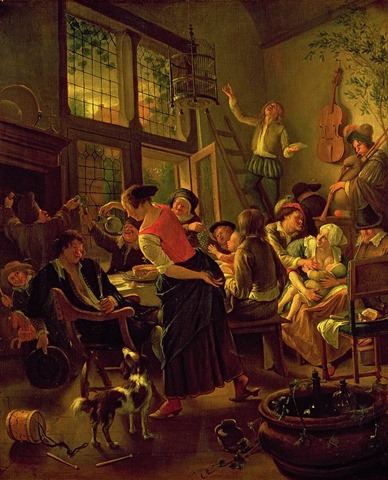
I suppose chopping wood involves most of these qualities of engagement but it is not a genuine focal practice. Unlike chopping wood, genuine focal practices involve the whole person, a full range of human capacities, in an activity that is inherently meaningful and in which we strive for excellence. The practice of cooking is a perfect example. The culture of the table involves more than just heating food and consuming it. It is a place where family comes together and ideals are acted upon and reinforced. It is a dialogue with culinary traditions, a intimate communion between imagination, ideals, materials, ingredients, and methods. The respectful engagement with one’s environment characteristic of a focal practice is wide and deep.
Focal practices integrate body and mind, the acting subject merges with the environment in sympathetic union, and means and ends lose their separation. The distinction between means and ends, upon which Kant bases has judgment about what is and is not art, collapses with focal practices because the productive activity itself carries meaning. The product is only the surface of an ocean of meaning.
Of course all of the arts are focal practices—both the practice of the artist and the practice of attentive observers require the respectful engagement with one’s environment. Thus, works of art have intrinsic value because they embody the highest level of exertion, skill, imagination, and transcendence of which human beings are capable.
The finished product–the work of art–is the expression of artistic practice and that is why we value it, not just for its pleasurable effects on us but because of what it embodies.
 Exploring the Philosophy of Food and Wine