
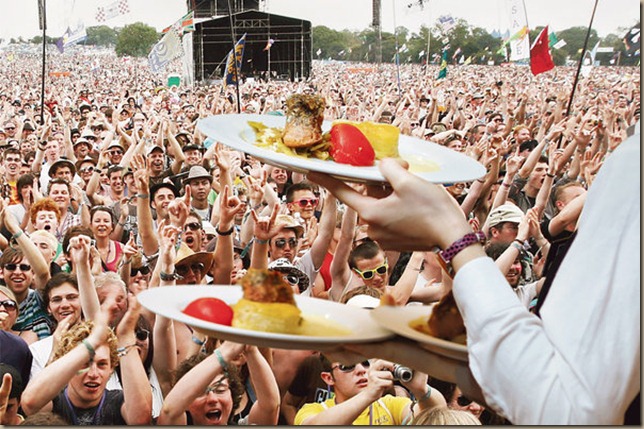
The “Food is the New Rock” meme has received a lot of discussion (here and here), I guess because of this NY Times report on the Great Googamooga festival:
For decades, food was an afterthought at rock concerts and festivals, where experiencing the rush of live music meant enduring an icky wasteland of cold pizza, warm beer and stale pretzels. But over the last five years or so, gatherings like Outside Lands and Lollapalooza have responded to a national surge in culinary consciousness by upgrading the grub to epicurean levels and welcoming top chefs into the tent.
Now the viands are about to upstage the bands. The headliners at the Great GoogaMooga, a convergence of food and music that will devour part of Prospect Park in Brooklyn on Saturday and Sunday, are star chefs like April Bloomfield, Tom Colicchio and Marcus Samuelsson, serving a feast of elevated street food.
This sudden interest in food at rock concerts is continuous with the extraordinary growth in the public’s interest in food-related entertainment like the Food Network and food-related activism such as the slow-food movement, locavorism, etc.
So is food to the early 2000’s as rock was to the 60’s? There are some striking parallels.
The cultural protests of the 1960’s were, in part, a response to the perception that American society had become excessively conformist and repressed; the authentic individual was in danger of being swallowed up by the emerging corporate culture described in William White’s The Organization Man. Rock music with its loud, in-your-face expressiveness, throbbing, incessant rhythm, sexually liberating messages, and romantic veneration of guitar players as heroes was the embodiment of that search for authentic individualism well before the Vietnam War became a galvanizing issue.
A search for authenticity and an anti-corporate mentality also drives some of the current interest in food. The focus on fresh, local ingredients, the interest in how ingredients are influenced by where they are grown, the search for authentic ethnic cuisine, artisanal cheese, etc. suggest a longing for authenticity. Those factors as well as a concern for animal welfare and sustainability are part of a protest against the depredations of industrial agriculture.
The romantic individualism nonsense is in part replicated by chefs as “rock stars” –rock star chefs are just as dependent on an army of workers slaving away in the galley as the “guitar gods” were dependent on band mates to hold the rhythm together. In fact, chefs may have a greater claim to genuine expertise. Chefs need considerable organizational skills, business acumen, and a knowledge of ingredients. “Guitar gods” just had to play fast and look pretty. (Yes. I know there were exceptions)
Of course the 60’s and the present are alike in that both anti-corporate protest movements were dependent on corporations for their existence. The more things change…..
But this explanation of the parallels between rock and food only goes so far. The vast majority of rock fans in the 60’s and “foodies” today are not much involved in a protest movement. We can’t ignore aesthetics in explaining cultural trends.
Part of the attraction of rock music was that it exposed a new way of listening to music. The introduction of electronic instruments and electronic processing meant that rock was defined by the production of new soundscapes. Rock music had textural layers and a focus on timbre every bit as complex and intriguing as classical music. This focus on texture and timbre was enhanced by the use of the human voice to express individual personality rather than a “pure” operatic tone. The difference between the Stones and the Beatles had little to do with song structure, melody, or harmonic structure—all of which could be analyzed in 2 minutes by any first semester music theory student. The difference was their sound, and every rock band, to the extent they were concerned with originality, was striving for a new way to sound.
I suspect the recent interest in food is in part driven by new ways of tasting. The increasingly globalized food trade and the movement of populations via immigration has made new flavors available to anyone who lives near an urban area. And food science and molecular gastronomy have made kitchen experimentation an exciting field driven by constant innovation.
Thus, our age is unique in the possibilities presented for expanding the pleasures of the palate—and human beings, when left to their own devices, seldom miss an opportunity to enhance their pleasure.
At bottom it is aesthetics driven by technology that explains both rock stars and chefs as rock stars.
 Exploring the Philosophy of Food and Wine
One comment